Home The Real History of Hoonah, Alaska

Before it was a cruise stop

The Real History of Hoonah, Alaska

Hoonah isn't just the town beside the cruise port — it's the resettled homeland of the Huna Tlingit, one of the oldest continuously present peoples in Southeast Alaska. Here's the real story, independently sourced.

Who are the Huna Tlingit?

Hoonah is the ancestral home of the Huna Tlingit, one of the oldest continuously present peoples in Southeast Alaska. Their homeland was originally in what is now Glacier Bay, until an advancing glacier during the Little Ice Age forced them out in the 1700s. Around 1754, the four Huna clans resettled about 20 miles south at a site they called Gaawt'ak.aan, later renamed Xunaa — Hoonah — meaning "where the north wind doesn't blow." Hoonah is still home to the Hoonah Indian Association, a federally recognized tribal government, and to Huna Totem Corporation, the Alaska Native village corporation formed under the 1971 Alaska Native Claims Settlement Act.

The original homeland

A homeland lost to ice

For centuries, the Huna Tlingit lived and thrived in what's now Glacier Bay National Park, sustained by its fish camps and villages. During the Little Ice Age, an advancing glacier swept through the bay in the 1700s, overrunning the villages of the four primary Huna clans and forcing them out of their homeland entirely. It's one of the only documented cases in North America of Indigenous communities driven out of a place by glacial advance rather than by people. They would not have a permanent clan house back in that homeland again for more than 250 years.
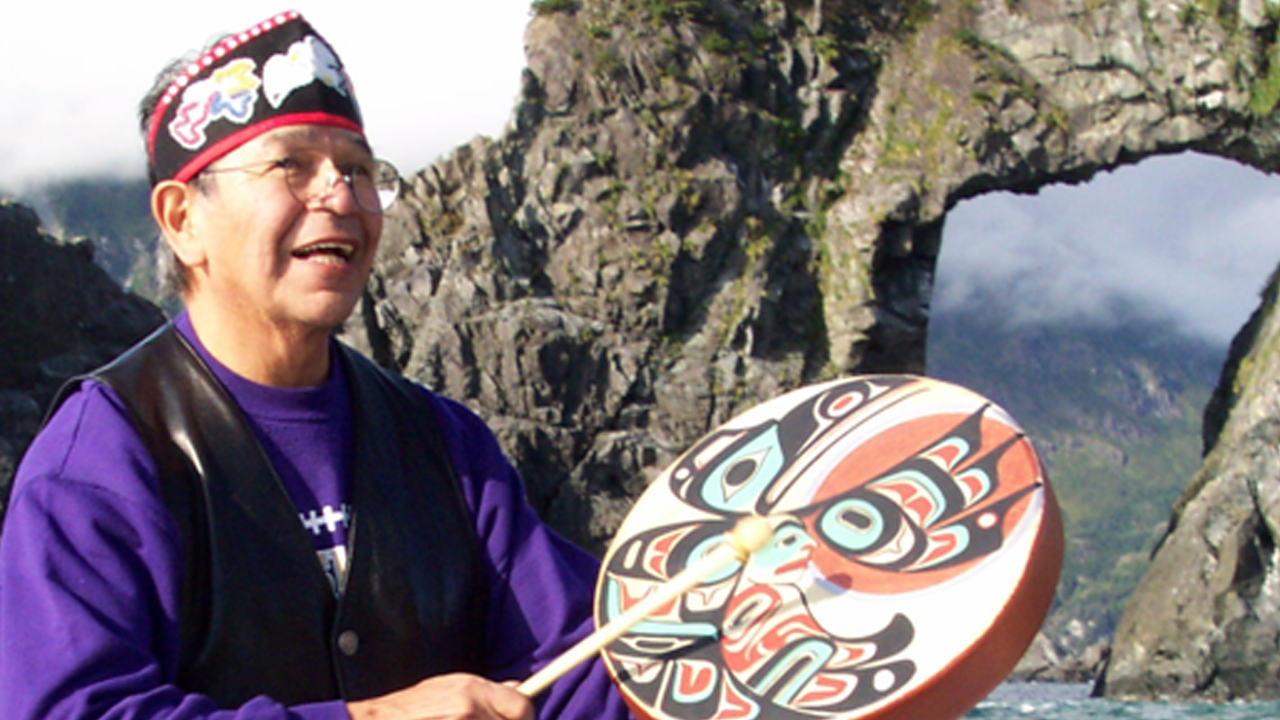
Glacier Bay, the original homeland of the Huna Tlingit before the Little Ice Age glacial advance
Glacier Bay as homeland — NPS photo, courtesy of the National Park Service.

Resettling south

The move to Hoonah

Displaced from Glacier Bay, the four Huna clans moved roughly 20 miles south and, around 1754, settled at a site they named Gaawt'ak.aan — "village by the cliff." Over time the name became Xunaa (anglicized as Hoonah), meaning "where the north wind doesn't blow" — a practical description of a town tucked into a spot sheltered from the region's harsh winter winds. That settlement is the same town that exists today, one of the oldest continuously inhabited Tlingit communities in Southeast Alaska.

1880s–1930s

Contact, commerce, and change

A trading post arrived in 1880, followed by a Presbyterian mission and school in 1881, bringing the first sustained outside commercial and institutional presence to the area. In 1912, the Hoonah Packing Company opened a salmon cannery on the site that would, generations later, become Icy Strait Point. Hoonah's own tribal government, the Hoonah Indian Association, became a federally recognized tribe in 1939 when its members ratified their constitution and bylaws — it remains the sovereign governing body for the Tlingit people of Hoonah today.

1944

The fire that reshaped the town

A devastating fire tore through much of the town in 1944, destroying historic homes and, with them, irreplaceable Tlingit cultural artifacts that couldn't be replaced. The federal government helped the town rebuild using repurposed World War II military housing — buildings residents still refer to today as the "war houses." Hoonah incorporated as a First Class City in 1946, two years after the fire.

2016

Returning to Glacier Bay

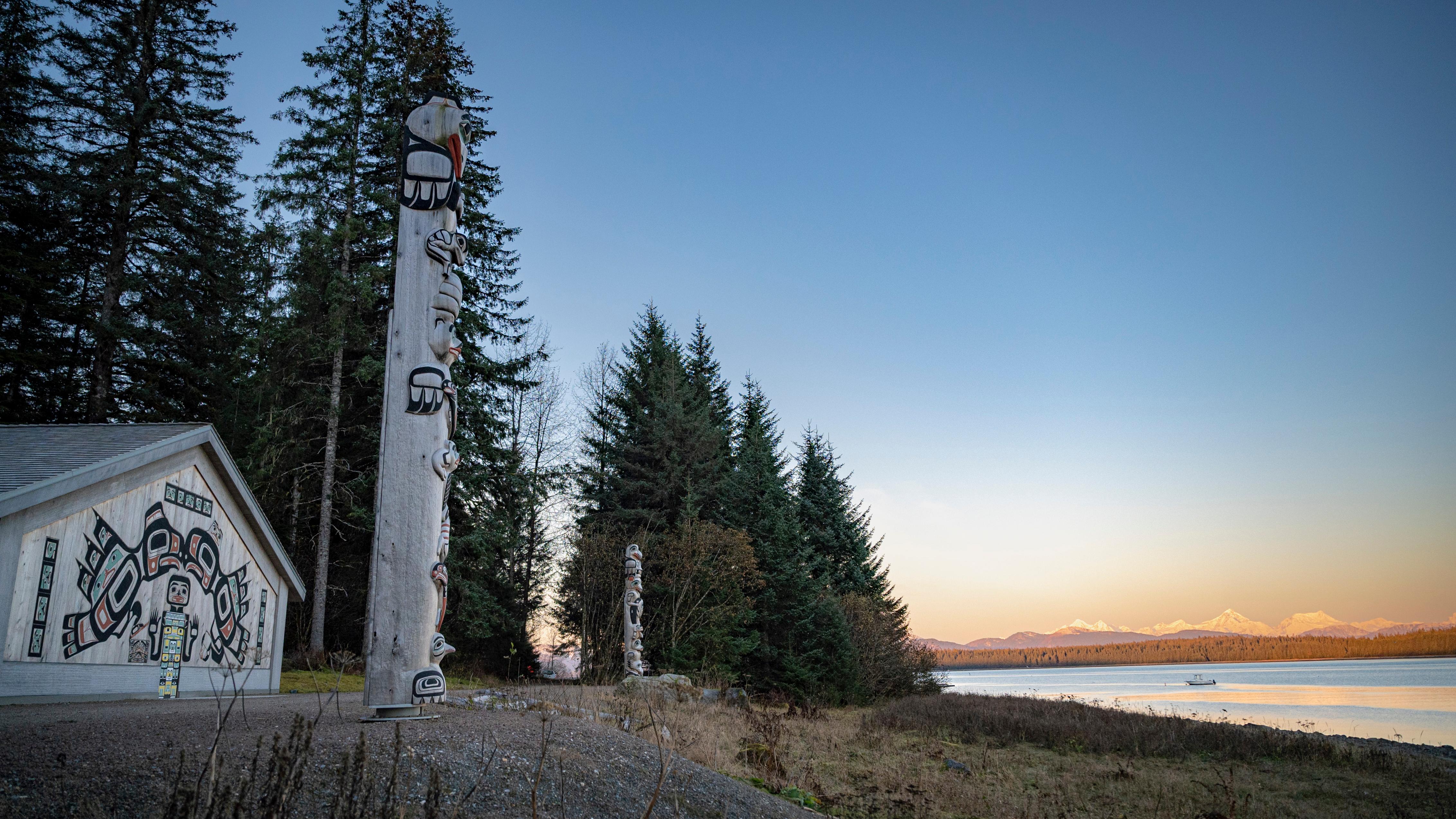
For over 250 years after being driven out, the Huna Tlingit had no permanent clan house in their original Glacier Bay homeland. That changed in 2016. The Hoonah Indian Association partnered with the National Park Service on a seven-year project to build Xunaa Shuká Hít — the Huna Ancestors' House — a 2,500-square-foot cedar clan house in Bartlett Cove, inside Glacier Bay National Park itself. Master carvers trained apprentices throughout the project, creating carved cedar house posts, panels, and totem poles depicting the histories of the four Huna clans. The house was dedicated on August 25, 2016, in a "Return to Homeland" ceremony that coincided with the National Park Service's 100th anniversary — the first permanent Tlingit clan house in Glacier Bay since the glacier drove their ancestors out.

Two carved totem poles in front of Xunaa Shuka Hit, the Huna Ancestors' House, in Bartlett Cove
Totem poles in front of Xunaa Shuká Hít, the Huna Ancestors' House — NPS photo, courtesy of the National Park Service.

Hoonah now

A living community, not a history exhibit

Hoonah is still a living Tlingit community, not a historical exhibit. The Hoonah Indian Association continues to govern locally and run programs for elders, youth, fisheries, and cultural preservation. Huna Totem Corporation, incorporated in 1973 as a village corporation under the Alaska Native Claims Settlement Act, has grown from 876 original shareholders to more than 1,350 today, all connected by aboriginal heritage to Hoonah and Glacier Bay — and it's Huna Totem that developed Icy Strait Point, the cruise port most visitors first arrive through. Cruise ships began calling at Icy Strait Point in 2004, but the town of Hoonah itself, a mile and a half up the road, has been here since long before that, and will be here long after.

Quick answers

Frequently asked questions

Is Hoonah named after a person?

No. Hoonah comes from the Tlingit word Xunaa, meaning "where the north wind doesn't blow" — a description of the town's sheltered location, not a person's name.

Why did the Tlingit leave Glacier Bay?

An advancing glacier during the Little Ice Age overran their villages there in the 1700s, forcing the four Huna clans to relocate. It's one of the rare documented cases of a community being displaced by glacial advance rather than by other people.

Is Icy Strait Point built on Tlingit land?

Yes. Icy Strait Point sits on land developed by Huna Totem Corporation, the Alaska Native village corporation representing Hoonah's Tlingit shareholders, on the site of a former salmon cannery that opened in 1912. See our Icy Strait Point guide for more on the cannery.

Can visitors see the Huna Ancestors' House?

Xunaa Shuká Hít is located in Bartlett Cove inside Glacier Bay National Park, not in Hoonah itself. It was built by the Hoonah Indian Association and the National Park Service and dedicated in 2016.

Is Hoonah still a Tlingit community today?

Yes. The Hoonah Indian Association is a federally recognized tribal government still based in Hoonah, and the town remains home to the descendants of the four Huna clans who resettled there in the 1750s.

Ready to see it for yourself?

Hoonah is a flat 1.5-mile walk from the cruise dock — independent restaurants, tours, and shops run by the people who live here.